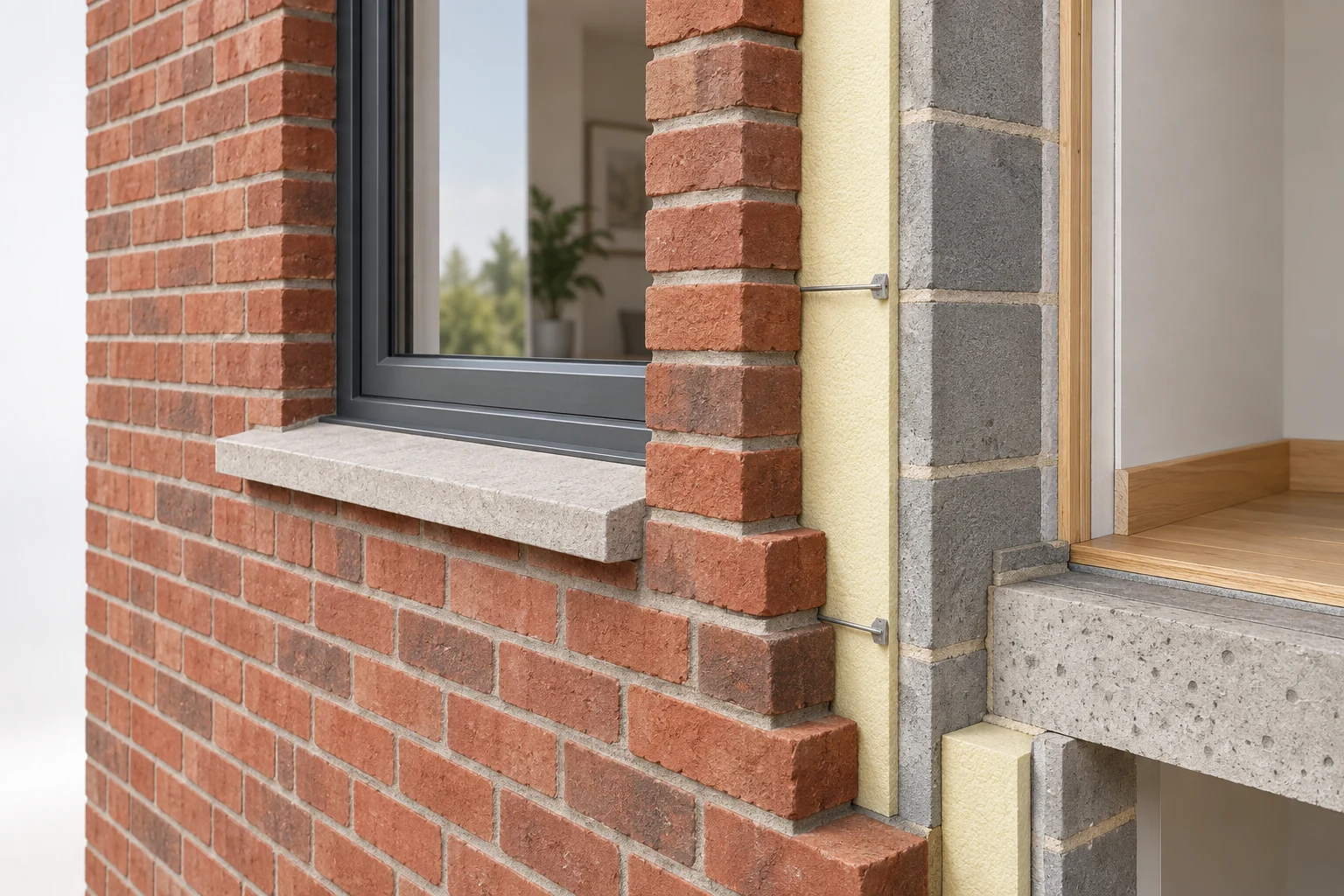
Three routes for external walls
The three routes are cavity filling, external insulation and internal insulation. A suitable cavity and the finishes that must remain help determine the choice.
| Method | When to investigate it | Main implication |
|---|---|---|
| Cavity insulation | An existing gap between two masonry leaves | The cavity and facade need a suitability inspection |
| External insulation | A new external finish is feasible | Wall thickness and junctions change |
| Internal insulation | The facade must stay or external work is impractical | Room dimensions and moisture behaviour change |
Identify the wall before choosing insulation
A solid wall has no cavity to fill. Building age offers clues but does not prove the construction. Extensions and original rooms may have different wall types. Ask for the proposed method to be identified for each elevation rather than assuming one solution suits the whole home.
Can different walls use different insulation methods?
Yes. A protected street facade may need an internal system, while an accessible rear wall can sometimes be insulated externally. A suitable cavity in an extension may allow a third approach. Each wall needs its own assessment, and the systems must connect at corners, floors and roof edges.
Choosing different methods does not remove the need for one coherent thermal and air-control boundary. The internal wall guide covers room-space and moisture implications; the external wall guide covers facade finishes and altered junctions.
Damp and thermal bridges need attention
Damp patches, damaged pointing and leaking rainwater pipes need investigation. Insulation does not repair these defects. Record where and when damp appears and mention earlier repairs.
Junctions at floors, windows and the roof can interrupt the insulation. These thermal bridges need details, especially when you renovate in stages. Coordinate new windows and insulation before fixing sill sizes or finishing the facade.
Specify a system, not just a material
EPS, mineral wool, PIR and bio-based materials have different applications. Fixings, vapour control and finishes form part of the system. Ask for the complete construction and thermal resistance. If air leakage is reduced or windows are replaced, review how the rooms will be ventilated.
Costs and price factors
Indicative installed costs are €15 to €40/m² for cavity filling, €45 to €65/m² for an insulated internal lining and €100 to €140/m² for external insulation with render, all excluding VAT. These are different wall systems. Repairs, altered services and complex junctions may add to the budget.
Stroomversneller is a quote request platform for insulation companies. Describe your home and intended work; the company assesses what is suitable and prepares its proposal.
Request a quote for this projectGrants: check the region and timing
Belgian support depends on the property’s region, applicant, work and application date. UK grant schemes do not apply automatically. Check the procedure before committing to the work, including any required prior audit. Read our dated overview for Flanders, Wallonia and Brussels. A quote request is not a grant application or confirmation of eligibility.
Frequently asked questions
Which wall insulation is best?
There is no universal choice. The cavity, facade condition, permitted alterations and renovation plans determine what is suitable.
Will thermal insulation stop neighbour noise?
Not necessarily. Noise transmission through the complete construction needs a separate acoustic assessment.
Can I insulate only one elevation?
It can be a separate project, but the junctions with untreated walls and future work still need a plan.