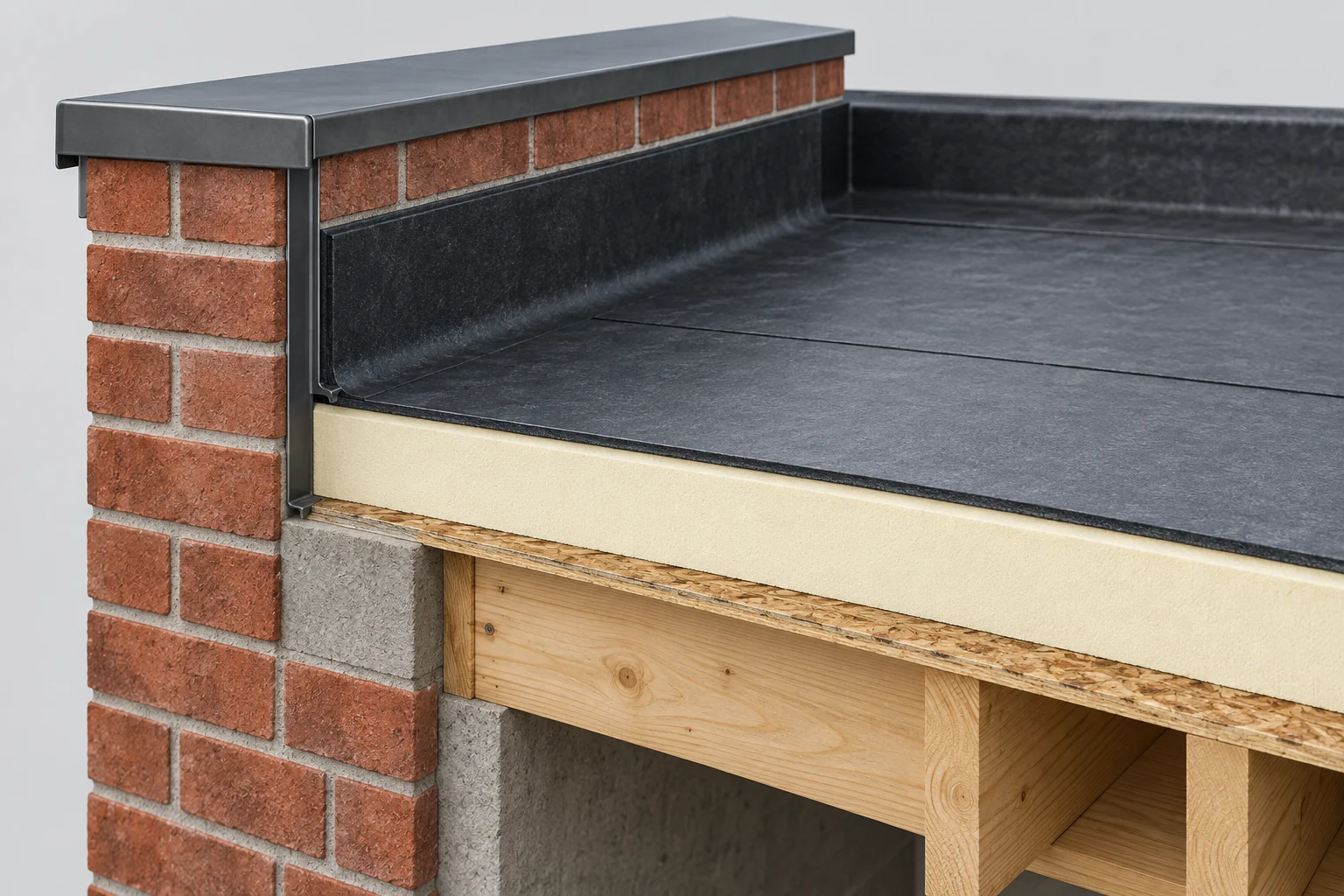
Where the insulation sits matters
In a warm roof, insulation sits above the deck and below waterproofing. In an inverted roof, it sits above the waterproofing. Insulating below the deck creates moisture risks.
| Roof arrangement | Insulation position | Design considerations |
|---|---|---|
| Warm roof | Above the deck, below waterproofing | Vapour control, fixing and upstands |
| Inverted roof | Above waterproofing | Suitable system, ballast and loading |
| Cold roof | Below the deck | Moisture risks; not a default renovation recommendation |
Assess the existing roof
The visible membrane does not reveal moisture or defects in the underlying roof layers. The existing build-up needs assessment before extra insulation is added; some cold-roof arrangements require complete renovation.
Is a compact roof the same as a cold roof?
No. A compact timber roof fills the space between the joists without a ventilated gap and requires a carefully designed moisture strategy. It is a specific construction, not permission to add insulation beneath any existing flat roof. The internal membrane, roof deck, exterior layers and drying conditions must work together.
Solar panels, terraces and green roofs can shade the waterproofing and change drying conditions. Have those additions assessed before choosing the build-up. A warm compact roof with insulation above and between the joists is another engineered arrangement; its layer thicknesses cannot be chosen independently.
Does a strong insulation board make the roof load-bearing?
No. The insulation, load-spreading layers and structural deck each need to resist their own design loads. A board’s compression rating does not establish whether the deck can carry a terrace, stored water, ballast or solar panels. Wind resistance and protection of the waterproofing also remain separate checks.
Match insulation to waterproofing and loading
PIR, mineral wool, EPS and XPS have application-specific uses. The selected product must suit the build-up, loads, fixing and membrane, such as EPDM or bitumen. Thermal resistance alone does not specify a watertight roof.
An existing membrane may sometimes remain in a carefully assessed renovation. Ask what role it will serve in the new system. Neither automatic removal nor automatic retention is a sound assumption without investigating its condition.
Include upstands, drainage and future additions
Extra thickness changes levels at doors, rooflights and walls. Ask for details of roof edges, falls and outlets. Mention planned solar panels, a green roof or ballast so that structural capacity and the complete system can be checked together.
Costs and price factors
Warm flat-roof insulation has an indicative installed cost of €70 to €115/m², excluding VAT. This is not a total price for every roof renovation: the waterproofing system, edges, drainage, removal and structural repairs need a defined scope. A damaged or complex roof may cost more than this range.
Stroomversneller is a quote request platform for insulation companies. Describe your home and intended work; the company assesses what is suitable and prepares its proposal.
Request a quote for this projectGrants: check the region and timing
Belgian support depends on the property’s region, applicant, work and application date. UK grant schemes do not apply automatically. Check the procedure before committing to the work, including any required prior audit. Read our dated overview for Flanders, Wallonia and Brussels. A quote request is not a grant application or confirmation of eligibility.
Frequently asked questions
Can a flat roof be insulated from inside?
Insulation below the deck can introduce moisture risks. Have the complete construction assessed and investigate suitable approaches above the deck.
Must old roofing felt be removed?
Existing roofing felt does not always need to be removed when insulating a flat roof. A sound membrane can sometimes remain if it has an appropriate role in the new roof. Wet or defective layers may need removal.
Can insulation be combined with a green roof?
Yes within a suitable designed system, including checks on loading, waterproofing, drainage and maintenance.