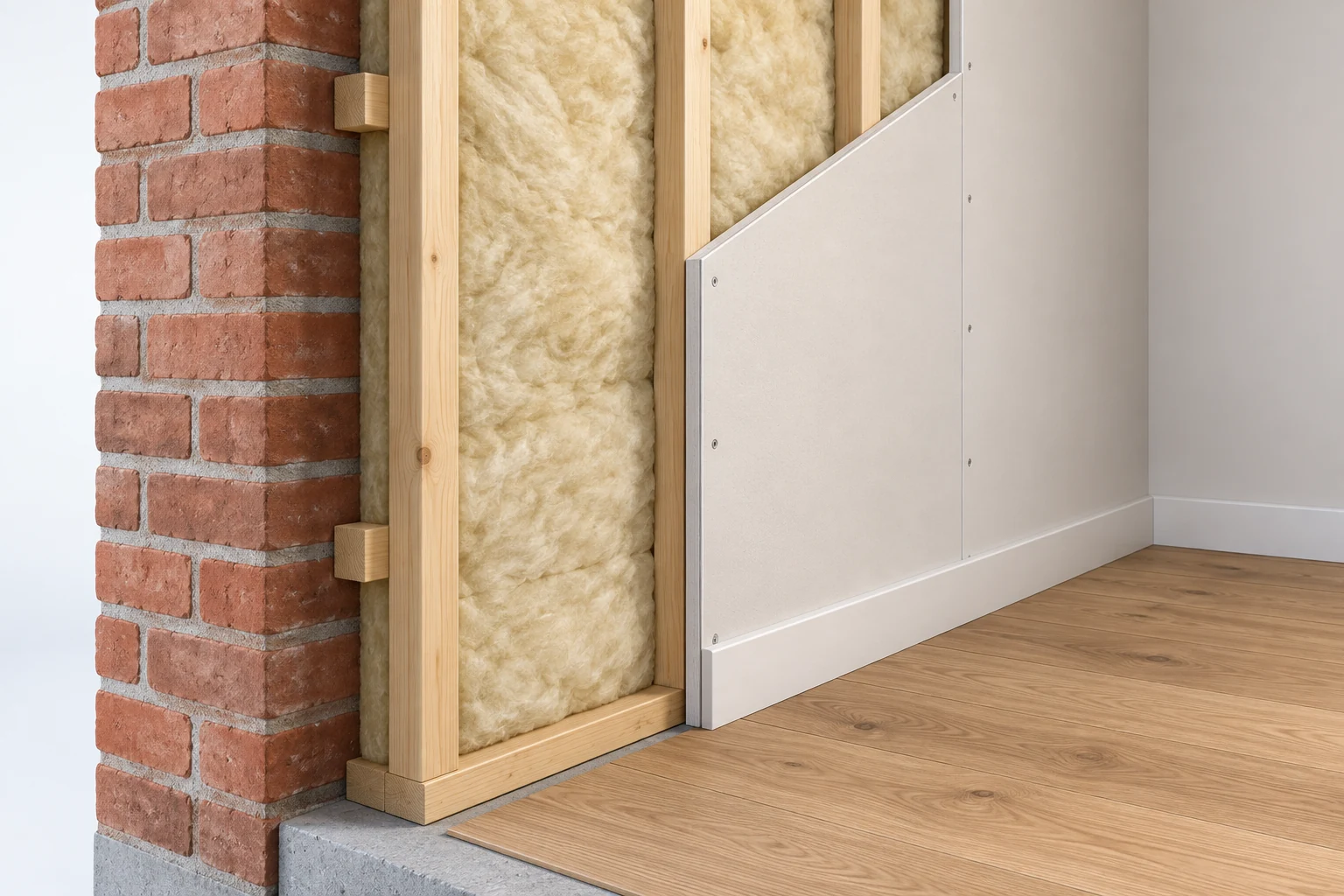
Understand the design principle
A vapour-controlled system limits transfer towards the cold wall. A capillary-active system manages moisture movement differently. The existing wall determines which design is suitable.
| System | What must be designed | Question to ask |
|---|---|---|
| Vapour-controlled construction | Continuous air and vapour control | How are sockets and junctions detailed? |
| Capillary-active system | Moisture management through compatible materials | Are adhesive, plaster and paint suitable? |
| Framed lining | Insulation, supports and facing layers | What is the total finished depth? |
Survey the facade before covering it
Rain exposure, external coatings and damp patches belong in the assessment. Covering a wet wall is not a repair. Embedded timber joist ends and floor junctions need particular attention because insulating internally changes the conditions within the wall.
Choose a complete moisture strategy
A separate vapour-control membrane is not the correct answer for every internal insulation system. Capillary-active systems also require a coherent design. Ask why the selected construction suits your masonry and indoor conditions.
PIR, mineral wool, wood fibre and mineral insulation boards cannot simply be substituted without checking the detail. Specify substrate preparation, installation and permitted finishes. Ask whether a project-specific moisture assessment is needed.
Measure the effect on the room
Request the full finished lining depth, including any service void. Check the remaining space at radiators, cupboards, door openings and window boards. Window reveals and junctions with floors, ceilings and internal partitions need details to limit thermal bridges. Identify which electrical and heating components must move.
How much floor area does a 10 cm lining take?
A finished lining 10 cm deep along one straight 6 m wall occupies 0.60 m² of floor area: 6 × 0.10 = 0.60. This example assumes one wall and includes the entire lining depth, not just the insulation. Two adjoining lined walls need a room-plan calculation so the corner is not counted twice.
Can I use any paint over a capillary-active system?
No. Adhesive, insulation, plaster and paint must be compatible with the chosen moisture-management system. A dense finish can restrict the drying behaviour the design relies on. Keep the specified finish requirements with the renovation records so later decoration does not inadvertently change the wall build-up.
Costs and price factors
An insulated internal lining using PUR/PIR or mineral wool has an indicative installed cost of €45 to €65/m², excluding VAT. Moving radiators and sockets, moisture repairs and painting may be additional items. The complete system must suit the existing wall and finish.
Stroomversneller is a quote request platform for insulation companies. Describe your home and intended work; the company assesses what is suitable and prepares its proposal.
Request a quote for this projectGrants: check the region and timing
Belgian support depends on the property’s region, applicant, work and application date. UK grant schemes do not apply automatically. Check the procedure before committing to the work, including any required prior audit. Read our dated overview for Flanders, Wallonia and Brussels. A quote request is not a grant application or confirmation of eligibility.
Frequently asked questions
Can internal insulation cause condensation?
An unsuitable construction or defective junction can adversely affect moisture behaviour. Survey, design and careful installation are essential.
How much room space will I lose?
The full finished lining depth determines this, not just the insulation thickness. Have the dimension shown on the room plan.
Does this treat a noisy party wall?
A separating wall between homes needs an acoustic assessment. Its suitable construction may differ from thermal insulation on an external wall.