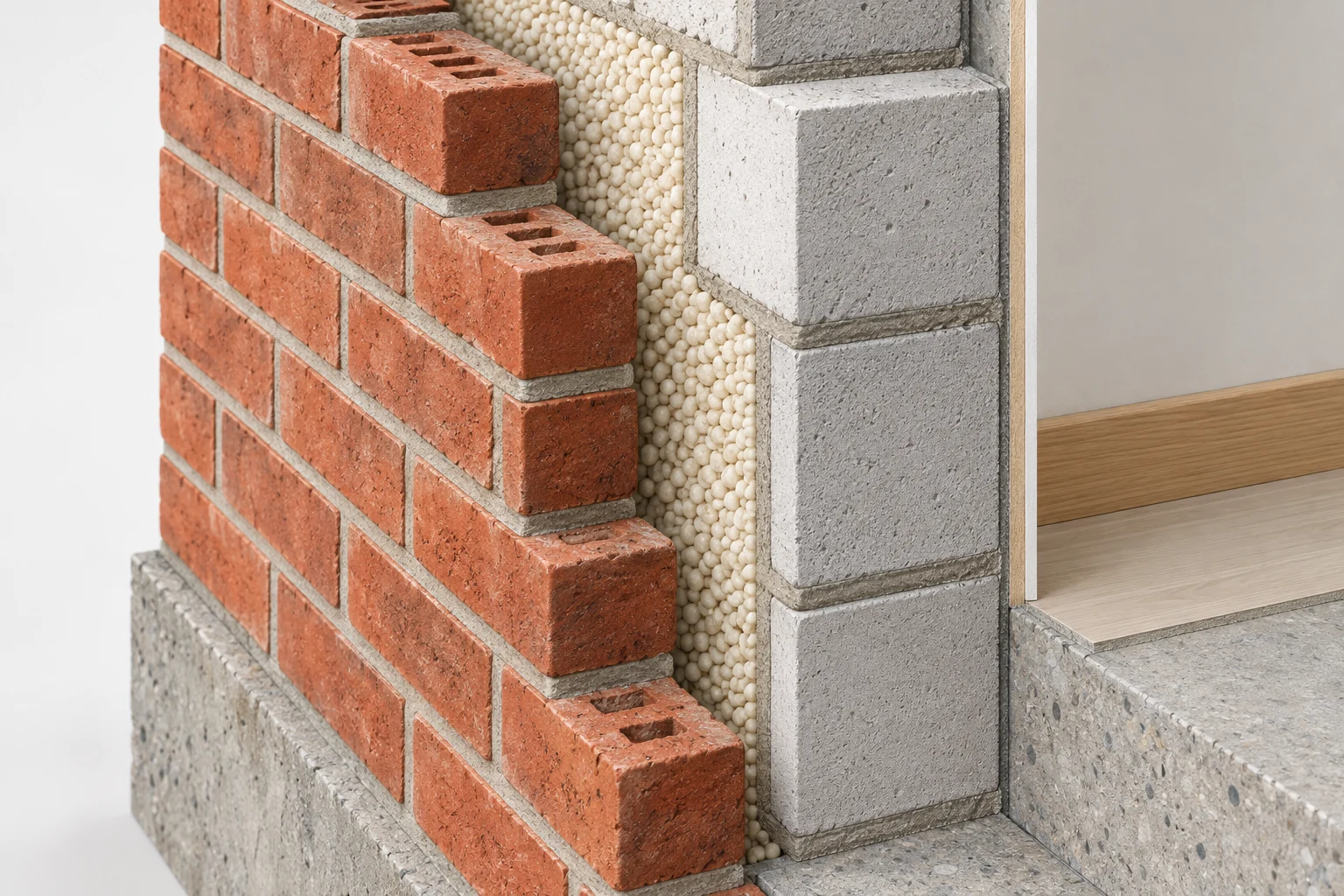
Materials used to fill an existing cavity
| Material | Form | Application requirement |
|---|---|---|
| EPS beads | Polystyrene beads with a binder | A suitable system and control of openings where material could escape |
| Mineral wool | Blown glass or stone wool fibres | A product and installation method meeting current application conditions |
| PUR foam | Foam injected on site | Product-specific preparation and processing conditions |
Inspect the masonry and the cavity
The survey should assess the facade and may use an endoscopic camera inside the wall. Ask about cavity width, mortar debris, existing insulation, cracks, pointing and exposure to wind-driven rain. Building age alone cannot confirm suitability.
A cavity width of at least 5 cm is one assessment criterion. The masonry, rain exposure, external finish and cavity condition must also be suitable. Width alone does not establish suitability.
Specify performance and moisture precautions
Request the product name, system documentation and relevant application conditions. Available cavity width and the material’s thermal conductivity affect thermal resistance. A personal energy-saving estimate also needs information about the rest of the home and its use.
Show the surveyor existing damp patches and previous repairs. Establish which defects need correction and which ventilation openings must be maintained. Filling the cavity does not repair rainwater leakage or damaged masonry.
What can the survey actually establish?
An endoscopic camera shows the cavity at the points inspected. It does not establish that every wall has the same construction. Extensions, different elevations and junctions may need separate checks. The Belgian technical framework for this filling method covers nominal cavity widths of at least 5 cm; width alone does not establish suitability.
How much thermal resistance can the cavity provide?
Divide the insulation thickness in metres by the product’s thermal conductivity. With an assumed lambda of 0.034 W/(m·K), a 5 cm layer gives R = 1.47 m²K/W; an 8 cm layer gives R = 2.35 m²K/W. These calculated examples describe the insulation layer only. They do not predict the complete wall’s U-value or your heating bill.
The usable cavity limits the thickness. EPS beads are polystyrene, not glass wool. Each proposed product needs its own declared performance and application conditions, including the current requirements for blown mineral wool.
What happens during installation?
After the survey and necessary repairs, the installer protects openings that must remain functional, drills according to the system, fills the cavity and makes good the holes. Filling checks and product records complete the work. An unsuitable cavity calls for an assessment of external or internal wall insulation.
What are the benefits and limitations?
Cavity filling reduces heat loss without taking up living space and usually preserves the interior finish and facade appearance. It does not automatically resolve thermal bridges at junctions, leaking rainwater details or damaged masonry. A reliable payback estimate also needs heating use, energy prices and the existing wall performance.
Costs and price factors
Cavity wall insulation has an indicative installed cost of approximately €15 to €40/m², including material and excluding VAT. Cleaning the cavity, removing old fill and repairing masonry may add to the cost. Available thickness, the selected system and access also affect the final project price.
Stroomversneller is a quote request platform for insulation companies. Describe your home and intended work; the company assesses what is suitable and prepares its proposal.
Request a quote for this projectGrants: check the region and timing
Belgian support depends on the property’s region, applicant, work and application date. UK grant schemes do not apply automatically. Check the procedure before committing to the work, including any required prior audit. Read our dated overview for Flanders, Wallonia and Brussels. A quote request is not a grant application or confirmation of eligibility.
Frequently asked questions
Can an already insulated cavity be topped up?
Only if the existing material, condition and remaining space are compatible with the proposed system. Topping up needs a specific assessment.
Can cavity insulation cause damp?
An unsuitable wall or poor installation can create problems. The facade survey and treatment of existing defects are essential.
How can I tell whether my wall has a cavity?
Plans and building age provide clues, but an on-site investigation should confirm the construction and condition.