Turn a noise complaint into a useful brief
Voices generally indicate airborne noise, footsteps indicate impact noise and echo indicates reverberation. Identify the noise type before choosing the construction.
| What you hear | Possible mechanism | What to investigate |
|---|---|---|
| Voices or television next door | Airborne sound | Separating wall, gaps and flanking paths |
| Footsteps or moving chairs above | Impact sound | Floor finish, resilient layers and ceiling |
| Echo within the room | Reverberation | Sound absorption on room surfaces |
| Road traffic | Sound through the facade | Windows, glazing, vents and junctions |
Sound absorption is different from sound insulation
An absorbent panel can reduce reflections within a room. That does not mean it will adequately reduce noise passing through a separating wall. Describe your problem before choosing decorative panels or acoustic foam.
Consider the complete wall, floor or ceiling
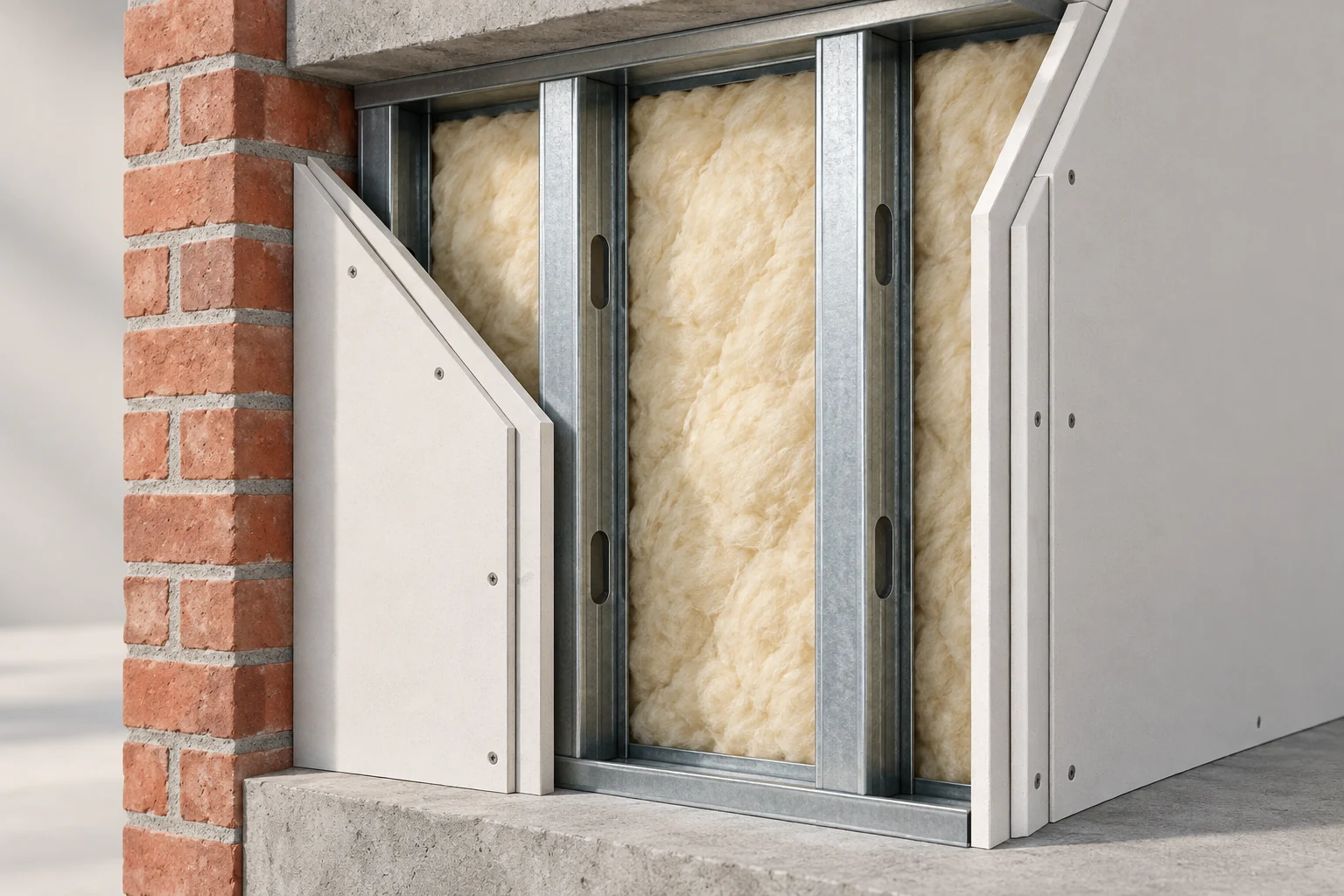
An acoustic lining combines a support system, cavity infill and facing layers. Fixings and perimeter junctions influence performance. A quote naming only mineral wool does not describe a complete solution.
For footsteps, treatment at the floor where the noise originates deserves consideration. A ceiling below is a different intervention. Sound can bypass a new lining through adjoining floors and walls; these flanking paths must be included in the diagnosis.
Agree on an achievable improvement
Record the rooms, likely source, timing and character of the noise. Mention recent alterations to either home. Ask whether measurements are needed before choosing the design. A laboratory decibel rating applies to a tested construction, not automatically to the result in your existing building.
Why can sound remain after a new wall lining?
Sound can reach the room through an adjoining floor, ceiling or wall, even when the separating wall is improved. For example, lining a party wall does not disconnect a continuous floor structure. The design must address the important transmission paths together; adding more wool to the same lining may not solve the remaining problem.
Which Belgian acoustic standard applies to homes?
NBN S 01-400-1 describes acoustic criteria for residential buildings. The 2022 edition is the good-practice reference for housing projects with a planning-permit application after 1 January 2023. An acoustic specialist should identify the edition and project requirements that apply, especially for an existing home or a partial renovation.
Costs and price factors
For dry acoustic floor elements with levelling, an indicative budget is approximately €120/m², including installation and excluding VAT. This covers that floor construction, not a complete room with treated walls and ceilings. Diagnosis, flanking paths and the required performance determine the other work. Reducing reverberation within a room is a separate intervention.
Stroomversneller is a quote request platform for insulation companies. Describe your home and intended work; the company assesses what is suitable and prepares its proposal.
Request a quote for this projectFrequently asked questions
Does mineral wool stop neighbour noise?
Mineral wool can form part of an assembly that reduces neighbour noise. Mass, connections, airtight junctions and other sound paths also matter.
Can upstairs noise be treated?
Yes, a suitable acoustic floor or ceiling assembly can reduce it. Impact noise may need treatment at the source on the floor above, with agreement from the neighbours.
Does a high insulation R-value prove acoustic performance?
No. Thermal resistance and sound insulation describe different properties. Ask for evidence about the complete acoustic assembly.